
Caldwell Projected Versus Actual Release
“Projected release date” is TDCJ's term for a calculated date in a state prison record. Classification and Records determines it from the sentence, offense date and type, time credits, and the rules that apply to that case. It is an estimate within the corrections record, not a promise that the person will leave a facility at a set hour.
An actual release is a completed custody event. At Gregory S. Coleman Unit, it may be parole, mandatory supervision, discharge, or a transfer to another authority. A transfer is continued custody. At Caldwell County Jail, a person may leave on bond, after a court order, at sentence completion, or by transfer. Those county events are documented by the jail release sheet and court or receiving-agency record, not by the TDCJ projected field.
A pretrial detainee has no sentence calculation. The court may set bond or issue a release order, but staff still must process the order and clear every warrant, hold, and detainer. The Caldwell County released-inmate search path explains how to obtain the county release record after that process ends.
Find Caldwell Projected Release Dates
Start with the person's present authority. The TDCJ inmate search includes only people currently incarcerated in a TDCJ facility. Search by exact last name and first initial, seven-digit TDCJ number, or SID; gender and race can narrow a match. A current detail may show the unit, offenses, projected release date, and parole-review data. Names alone are weak identity proof.
- Identify county or state custody. Caldwell County Jail is a local detention facility. Coleman Unit is a TDCJ prison. Their date records are not interchangeable.
- Search the current TDCJ record when applicable. Match the TDCJ number or SID and read the whole detail, including projected date, maximum expiration, location, and parole-review fields.
- For a jail case, read the court record. Ask the County Clerk about misdemeanor records or the District Clerk about felony records. Obtain the judgment, sentence, bond order, or release order.
- Ask the maintaining office. Call Caldwell County Jail at 512-398-6777, option 1, for current operational status. Use TDCJ's information lines for a prison calculation.
- Confirm after the date. Obtain the jail release sheet or TDCJ release certificate. If the record says transfer, follow the receiving authority.
TDCJ also provides an email information route. Send a full name and TDCJ number to pia@tdcj.texas.gov. If the number is unknown, supply the exact date of birth, or approximate age and county of conviction. Ask for current incarceration, incarceration history, and projected release information. A former-prisoner request should specify the release or discharge date, type, and certificate.
The TDCJ telephone page lists 936-295-6371 and 800-535-0283 for general location and inmate information. Call 844-512-0461 for pre-vote parole information and 512-406-5202 after a favorable vote for release-processing status. Each line answers a different stage.
Read the projected date beside the maximum-expiration and parole-review information. The earliest number on a screen is not always the controlling release path. For example, a mandatory-supervision decision can alter which date TDCJ displays, and a favorable parole result can remain subject to release-plan work. Record the access date and TDCJ number so later agency staff can identify the same term.
Texas Time Credits and Caldwell Releases
Texas Government Code Chapter 498 governs good conduct time. Credits can affect classification, parole eligibility, or mandatory-supervision calculations according to the offense and sentence, but they do not simply erase calendar days from every term. Loss of credits through discipline can alter a projection where the law makes those credits relevant.
There is no universal Texas rule requiring every prisoner to serve 85 percent of a sentence. For specified serious offenses, Government Code Section 508.145(d) commonly sets initial parole eligibility at actual calendar time equal to half the sentence or 30 years, whichever is less, without good-time consideration. Other offense-date and eligibility provisions can produce a different result. Section 508.149 also excludes listed cases from mandatory supervision.
For a qualifying offense before September 1, 1996, the TDCJ projected date may reflect when flat time plus good time equals the sentence if parole has not occurred. For an eligible later offense, Board approval for mandatory supervision is discretionary. A denial may move the display to maximum expiration or discharge, while a later approval can change it again. An ineligible case may show the projected and maximum-expiration dates as the same date.
Caldwell County published no local jail good-time formula or weekend-release rule. A county sentence should be checked against the signed judgment, jail time sheet, credited days, and other holds. Do not import a TDCJ prison calculation into the Caldwell County Jail record.
Note: A case-specific time calculation requires the official time sheet and governing judgment, not arithmetic based on a general web summary.
Why Caldwell Release Dates Change
A date changes when the facts or law in the calculation change. Read the current full detail rather than saving one date and treating it as fixed. The source of the change also determines which office can explain it.
| Factor | Possible effect | Best confirmation |
|---|---|---|
| Good-time award or loss | Changes a credit-based calculation where applicable | TDCJ time calculation and Chapter 498 |
| Parole denial or later approval | Can move a projected date toward maximum expiration or a new approved plan | BPP result and current TDCJ detail |
| Required program or plan | Delays physical departure after a favorable vote | Review and Release Processing |
| Court order or sentence correction | Changes the legal term, credit, or release authority | Certified court order and agency recalculation |
| Detainer or hold | May cause transfer instead of community release | Holding and receiving agencies |
| New case or revocation | Can add custody or alter the supervision path | Court, BPP, TDCJ, and jail records |
A favorable BPP action and continued custody at Coleman Unit can both be correct. The decision may require an approved residence, a program, a future release month, or certificate processing. The Review and Release Processing page identifies the state unit that carries out eligible releases.
The official Review and Release Processing screen is captured below from its TDCJ source.
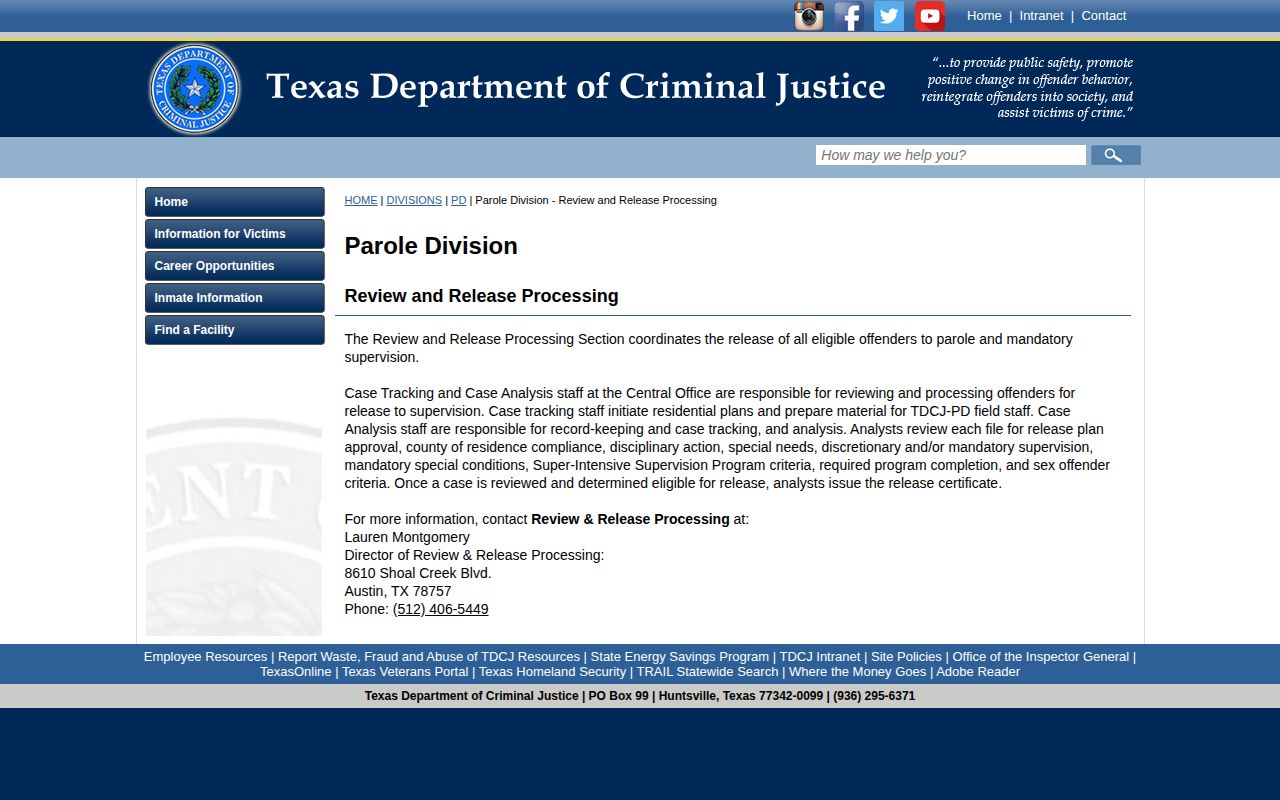
That state process belongs to TDCJ prisoners, including eligible people leaving Coleman Unit, rather than people awaiting court action in the Caldwell County Jail.
Confirm Caldwell Release Completion
For a county jail event, start with Texas IVSS-Counties for current status, then call the jail and request the existing booking and release sheet. IVSS can update around the clock, but it warns that people no longer in custody may not appear and that the display is not an official record. A no-hit does not prove release. The jail record should show whether Caldwell custody ended by community release or transfer.
For a TDCJ event, preserve the current projected field, review the parole result, and call the proper information line. After departure, request incarceration history and the release certificate. The current-only online search may stop returning the person, which is expected. That absence is not documentary proof of discharge.
A custody-change alert can help mark when to verify. The Caldwell County VINELink check covers the county-linked IVSS route and explains its notification limits. TDCJ Victim Services is a separate state-prison notification program. Neither alert substitutes for a certificate or release sheet.
When another authority takes custody, qualify the result. A Caldwell release to TDCJ is only a county handoff. A TDCJ release to another agency is not freedom from all custody. Match the destination to the receiving record before describing the event.
Caldwell Date Records After Release
Once a person leaves the TDCJ current search, use the email information service for incarceration history and a formal public-information request for the release certificate or discharge record. Give the full name, TDCJ or SID number, term dates, and the exact existing records sought. TDCJ's Public Information Act route accepts requests at PIA@tdcj.texas.gov or by mail to PO Box 4017, Huntsville, TX 77342.
For Caldwell County Jail, submit a narrow written request through the county public-information page. Identify the person, approximate booking dates, booking number if known, and ask for booked and released timestamps, release disposition or destination, holds, and receiving agency if maintained. A records request is a documentary process, so use the jail phone for urgent present-status questions.
Court records add legal context. The County Clerk handles misdemeanor court records, while the District Clerk handles felony and district matters. A judgment, bond order, dismissal, or release order may explain the authority for release, but it may not capture the exact moment staff cleared all holds and opened the door. Join the court record with the custody record.
If the sources disagree, ask what each one measures. A court order may authorize release while the jail still clears a detainer. A BPP result may approve parole while Coleman Unit still holds the person for a required program or certificate. A TDCJ projected date may change after a denial or recalculation. Keep each dated observation, contact the office responsible for the unresolved stage, and use the final release sheet or certificate as proof of the completed event.
Federal and immigration dates require different systems. A BOP locator release date concerns BOP custody, not Caldwell County Jail or TDCJ. ICE ODLS is a present-location tool and does not calculate a Texas sentence. If one authority transfers a person to another, report the limited fact that the first custody ended and verify the receiving record before describing a community release.
Keep the final record with its source and access date. A later correction, discharge entry, or receiving-agency record may clarify what the earlier projection could not show. Precise labels such as “released from TDCJ custody” or “transferred from Caldwell County Jail” preserve that distinction.
A formal TDCJ request should describe the existing records rather than ask the agency to calculate a new date. Request the time sheet or calculation maintained for the term, incarceration-history entries, projected and maximum-expiration fields, release certificate, and release or discharge date and type as applicable. Include the TDCJ or SID number and the relevant dates. The records can show which calculation controlled without turning a general statutory rule into a case-specific promise.
For a Caldwell jail sentence, request the judgment and documented jail credit from the proper clerk, then ask the jail for the custody-event or release record. If another agency hold appears, obtain the receiving record too. No official Caldwell source published a local good-time table, release-time schedule, weekend formula, or public release calculator. That absence makes the signed judgment and maintained agency calculation more important, not less.
A court order entered on one date may take time to reach staff and pass operational checks. It may also cover only one cause. Review all known causes, warrants, and detainers before treating the order date as the physical exit date. The release sheet remains the best county record for when Caldwell custody actually ended.
Note: Texas law calls for prompt production within a reasonable time; it does not promise every requested release record within ten business days.